
Our approach

Our approach to emotional intelligence

Mindshift Haven supports students and educators to develop emotional intelligence through practical training and coaching. Our approach focuses on five core competencies, with mindfulness and appropriate NLP-informed practices complementing the work.

Students in school uniforms raising their hands in a room.
Students raising their hands in a room.

What is emotional intelligence?

Understanding ourselves and others

Emotional intelligence is the set of skills we use to understand ourselves, connect with others and respond to everyday situations. It includes noticing feelings, managing reactions, staying motivated, understanding other people's perspectives and communicating well. At Mindshift Haven, we treat these as practical skills that can be developed.

Our framework

Five core competencies

Our work focuses on five connected competencies. Each one can support students and educators in different ways.

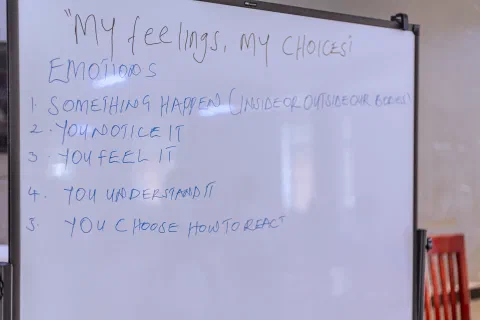
A whiteboard with handwritten notes and a numbered list used during a Mindshift Haven session.
A whiteboard used during a session.
01

Self-awareness

For students

Can help students, in age-appropriate ways, notice feelings, reactions and preferences as they happen, and recognise how these can affect choices and relationships.

For educators

Can help educators notice their own responses, mood and triggers, and understand how these can shape interactions in the classroom and with colleagues.

02

Self-regulation

For students

Can help students, in age-appropriate ways, find ways to pause and choose a response rather than acting on impulse, especially when emotions are strong.

For educators

Can help educators respond thoughtfully under pressure and model calm, considered responses for learners.

03

Motivation

For students

Can help students, in age-appropriate ways, build the willingness to keep trying, learn from setbacks and work toward goals that matter.

For educators

Can help educators sustain purpose and commitment in teaching and leadership, especially when demands are high.

04

Empathy

For students

Can help students, in age-appropriate ways, listen to others, consider different perspectives and recognise how others may feel.

For educators

Can help educators understand students' and colleagues' perspectives and respond with consideration.

05

Social skills

For students

Can help students, in age-appropriate ways, communicate clearly, cooperate, resolve everyday disagreements and build healthy relationships.

For educators

Can help educators communicate clearly, build trust and collaborate with colleagues and students.

Mindfulness and NLP-informed practice

Supporting awareness and reflection

Mindfulness practices can support present-moment awareness, helping participants notice their thoughts, feelings and reactions with more attention. Appropriate NLP-informed techniques can complement the training by supporting reflection on language, thinking patterns and communication. These practices are part of the Emotional Intelligence training and coaching; they are not presented as clinical or therapeutic treatment.

How the work is delivered

Practical and flexible delivery

Delivery can include group workshops, structured programmes, targeted sessions and school partnerships. Programmes can be discussed and tailored to the needs of students, educators or a school.

  • Group workshops
  • Structured programmes
  • Targeted sessions
  • School partnerships

Explore the services

Where the approach is applied

Learn more about the two primary services:

Student EI Training

Emotional Intelligence training for kindergarten, primary and secondary students, including school-based sessions and out-of-school enrichment programmes.

Explore Student EI Training

Start a conversation

Talk to Mindshift Haven about your students or educators.

Tell us about your setting and the needs you would like to address. We welcome an initial conversation.